In 2025, Orange Hats—independent volunteer legal observers supporting liberatory movements in Tkaronto/Toronto—documented a significant escalation in Toronto Police Service (TPS) interference during protests, particularly those in solidarity with Palestine. This year-in-review highlights:
- systemic patterns of targeted arrests;
- the largest mass arrest at a Toronto demonstration since 2021,
- severe police-Inflicted protester injuries with no accountability, and
- increasingly prolonged detention processing that functions as additional punishment.
Arrests of Legal Observers
TPS arrested two legal observers (LOs) in fall 2025 for performing standard LO duties1.
On September 24, at a protest at Toronto Metropolitan University, a legal observer was arrested for requesting an officer’s identification, as required under section 13(2) of the Code of Conduct for Police Officers, O Reg 407/232, and charged with obstructing a peace officer and criminal harassment (a charge that usually arises in cases of stalking and gender-based violence). Police imposed restrictive release conditions that barred proximity to uniformed officers and recording them while on duty, with extended post-paperwork custody adding further hardship.
On October 8, a second legal observer was violently thrown to the ground and punched by officers for attempting to obtain an arrestee’s name3 for legal support, then charged with obstruction. All charges from that day—including those against the eight others arrested at that event—were withdrawn.
These incidents represent an unprecedented direct attack on movement defence infrastructure in Toronto.
Largest Mass Arrest Since 2021
On July 19, 2025, during a Palestine solidarity march on Spadina Avenue, TPS (with Ontario Provincial Police support) conducted a coordinated operation leading to eleven arrests—the highest number at a Toronto protest since the 2021 Lamport Stadium encampment evictions.
Many arrests appeared to be selectively targeted at organizers and activists. This aligns with the “process is the punishment” approach: heavy resource deployment, excessive charges (almost always dropped later), and associated disruptions designed to deter ongoing activism without resulting in convictions. Multiple smaller mass arrests (up to nine people) occurred at other demonstrations throughout the year.
Police-Inflicted Injuries
Legal observers recorded over 100 serious protester injuries in 2025, including:
- 58 concussions
- 3 sprained shoulders
- 3 teeth knocked out
- 2 bruised orbital bones
- 2 Bruised ribs
- 1 cracked collarbone
- 1 dislocated shoulder
- 1 bruised tailbone
- 1 torn rotator cuff
- 1 torn ACL
And over 80 soft tissue injuries, mostly to wrists, arm, and legs, from overtight handcuffs, punches, and kicks.
Additonal cases involved near-strangulation by pulling a hijab (causing neck bruising) and confiscation of religious headwear during arrest.
These numbers are the result of OH’s independent data collection, not TPS stats. Despite legal requirements to do so4, officers submit few Use of Force reports about the injuries they cause at protests, and the Special Investigations Unit (SIU) initiate even fewer investigations. In previous years5, violent assaults on protesters have gone unreported within police systems. (2025 data will be searchable later in 2026.)
As in everyday life, much of the police violence at these protests has targeted the racialized communities that come out against settler colonialism and white supremacy. By simply declining to file reports, police also circumvent the Anti-Racism Act, 20176, which requires the Solicitor General to collect and analyze race-based data in police use of force.
Worse, they issued a media release congratulating themselves on a 13.5% decrease in use of force reports in 20247, suggesting that the only thing reduced was the number of reports filed.
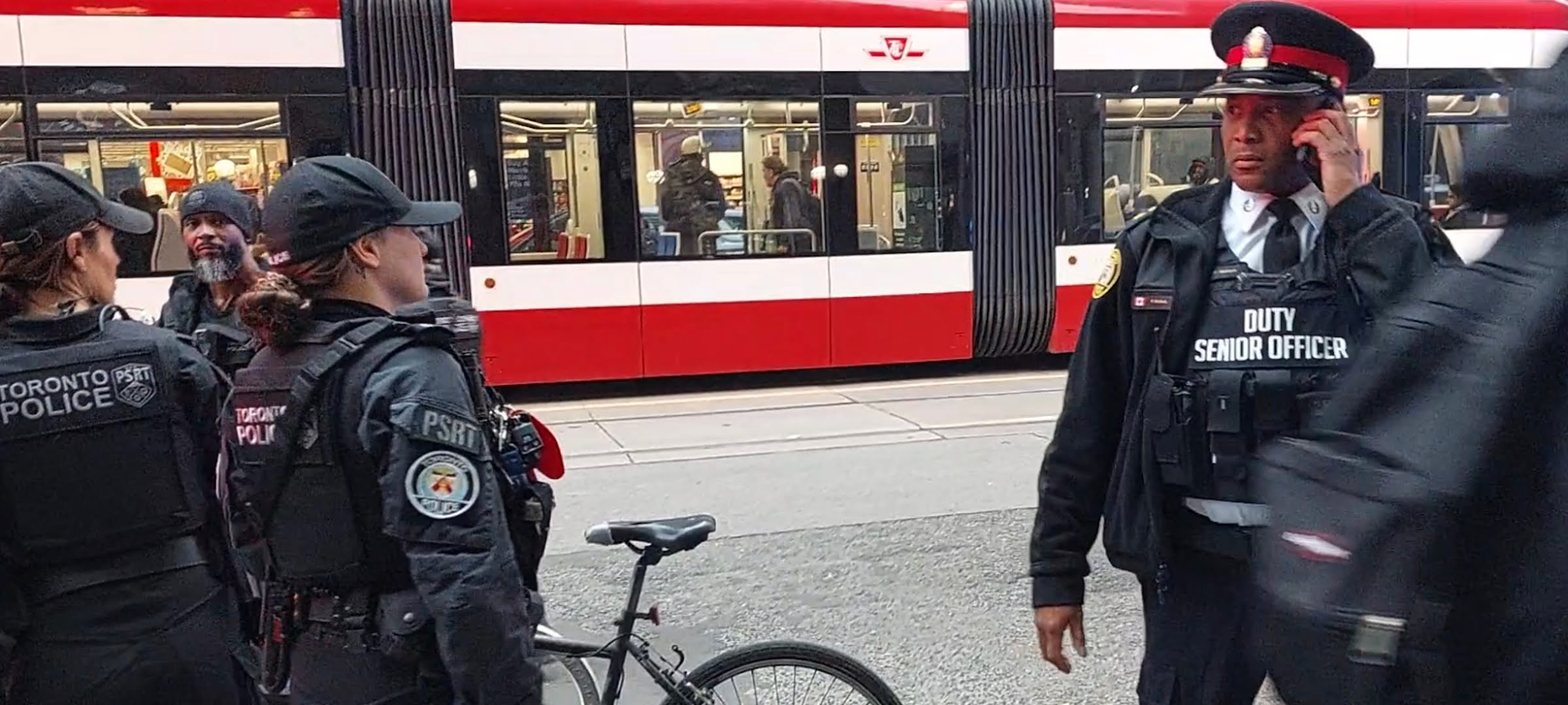
These incidents have taken place at the same time that TPS has been placing more senior officers on the ground at protests8. At times, those senior officers have carried out the assaults themselves9. That the majority of injuries have gone undocumented by TPS is not an accidental oversight by a few inexperienced officers. It appears to be a systematic cover-up of the routine violence of policing.
Escalating Delayed Processing and Detention
TPS increasingly delayed arrestee releases, turning short holds into overnight or multi-hour punishments. After the July 19 mass arrest, where the last arrest occurred around 6:00 p.m., releases began after midnight and concluded around 6:00 a.m. By October, the first release occurred near 7:00 a.m., with the last at noon, despite arrests taking place the evening before. Arrestees—often injured—faced delayed access to medical care, legal counsel, food, water, and family, while community jail support endured harsh conditions.
TPS’s attacks against the Palestine solidarity movement in particular are a calculated practice of strategic incapacitation10. Its unfettered violence against protesters, like all police violence anywhere, is not a failure of the state’s “accountability” measures: The system is working as intended.
These 2025 developments occurred amid substantial public spending on protest-related policing, including Project Resolute11, which exceeded $19.5 million by end-2024 and continued into 2025. TPS weaponizes the legal process together with sheer brutality to inflict a severe physical, mental, and financial toll on communities. No court process or finding of guilt is needed for the police to crack down; the structure of the law gives them carte blanche in the form of “police discretion.” Municipal, provincial, and federal politicians alike openly support this repression.
Echoing the abolitionist wisdom of decades prior, these strategies reiterate that police accountability will never come from the state. Time and time again, it is communities that protect ourselves from state violence and create safety on our own terms.
Recent events in the United States, particularly the shootings of two legal observers12 13, have underscored the dangers faced by those who challenge the state’s authority, question its policies, or expose abuses of power, as well as the lengths to which law enforcement will go to to avoid accountability.
This report draws from direct on-site observations, community-sourced medical documentation, and public records. Orange Hats remains committed to documenting police conduct and supporting liberatory movements in the face of these challenges.
For interviews, footage, additional data, or comment, contact orangehats[@]fastmail.com
Notes:
- https://en.wikipedia.org/wiki/Legal_observer ↩︎
- “While acting in the course of their duties, a police officer shall, upon request, provide their name, badge number and the name of their police service to any member of the public in a manner reasonable in the circumstances that allows the member of the public to identify the officer, unless the officer has reason to believe that doing so would undermine the safety of an individual.”
Ontario, Code of Conduct for Police Officers, O Reg 407/23, made under the Community Safety and Policing Act, 2019, SO 2019, c 1, Sched 1 (filed December 18, 2023), https://www.ontario.ca/laws/regulation/r23407. ↩︎ - Video of arrest available on request. ↩︎
- Use of Force reports are required “when members in the performance of their duty: (a) use physical force on another person that results in an injury requiring medical attention; (b) draw a handgun in the presence of a member of the public; (c) discharge a firearm; and (d) use any weapon, other than a firearm, on another person.”
Ontario Regulation 391/23: Use of Force and Weapons, under the Community Safety and Policing Act, 2019, ss. 13–17 (reporting requirements), Ontario e-Laws, https://www.ontario.ca/laws/regulation/r23391 ↩︎ - As an example, the Palestinian Youth Movement’s 2024 Land Day action (March 30, 2024) saw police brutalize protesters, including knocking one arrestee fully unconscious requiring hospitalization, plus several other serious injuries, including some caused by marching mounted units directly into the crowd, however, no corresponding Use of Force report is to be found in the database of reports.
Ontario Ministry of the Solicitor General, Police Use of Force – Main Records, 2024 [data set], version 1.0, in Police Use of Force Race-Based Data, Ontario Data Catalogue, data as of July 8, 2025, last updated August 29, 2025, https://data.ontario.ca/dataset/police-use-of-force-race-based-data/resource/ea9dc29c-b4f1-4426-b1f2-974ce995aca1. ↩︎ - Anti-Racism Act, 2017, SO 2017, c 15, https://www.ontario.ca/laws/statute/17a15 ↩︎
- Toronto Police Service, “Toronto Police Service Reports 13.5% Decrease in Use of Force Incidents,” news release, November 6, 2025, https://www.tps.ca/media-centre/news-releases/64485/ ↩︎
- Prior to 2025, the police leads at protests had been Staff Sergeants. As of the latter half of 2025, police leads have been Inspectors — easily spotted by the gold on their uniforms/badges instead of white. ↩︎
- Video of Inspector Bernardo punching protestors available upon request. ↩︎
- Patrick F. Gillham, “Securitizing America: Strategic Incapacitation and the Policing of Protest Since the 11 September 2001 Terrorist Attacks,” Sociology Compass 5, no. 7 (July 2011): 636–652, https://doi.org/10.1111/j.1751-9020.2011.00394.x. ↩︎
- Toronto Police Service, “Project Resolute” (policing costs related to demonstrations and community engagement amid Israel-Gaza conflict), reported as exceeding $19.5 million by end-2024 with continuation into 2025; see e.g. “Toronto police spent $19.5M on response to Israel-Gaza war protests last year: report,” CBC News, April 4, 2025, https://www.cbc.ca/news/canada/toronto/toronto-police-israel-gaza-protests-policing-report-1.7502044; and Toronto Police Service Board reports (2025 budget context). ↩︎
- Tiffany Wertheimer, “Renee Nicole Good: Who Was the Woman Killed by ICE in Minneapolis?,” BBC News, January 13, 2026, https://www.bbc.com/news/articles/c1jepdjy256o. ↩︎
- “Killing of Alex Pretti,” Wikipedia, last modified January 2026 (accessed January 29, 2026), https://en.wikipedia.org/wiki/Killing_of_Alex_Pretti. ↩︎